
Who Secures the Hospital?
Earlier this year we briefly highlighted the importance of clinical continuity in the age of rising cybersecurity threats aimed at hospitals and healthcare systems worldwide. The newly published results of The Black Book’s research give us a chance to discuss this topic in more nuanced way, bringing in wide and complex field of network and cybersecurity providers and how their interactions with healthcare providers shape this area.
The European healthcare cybersecurity market has expanded into a broad ecosystem of technology vendors, managed-service providers, systems integrators and specialist consultancies.
Yet the existence of many suppliers does not automatically produce a coherent security system. The market is highly specialised, while hospitals remain dependent on complex combinations of legacy infrastructure, clinical applications, connected devices, cloud platforms and external providers.
A market under pressure
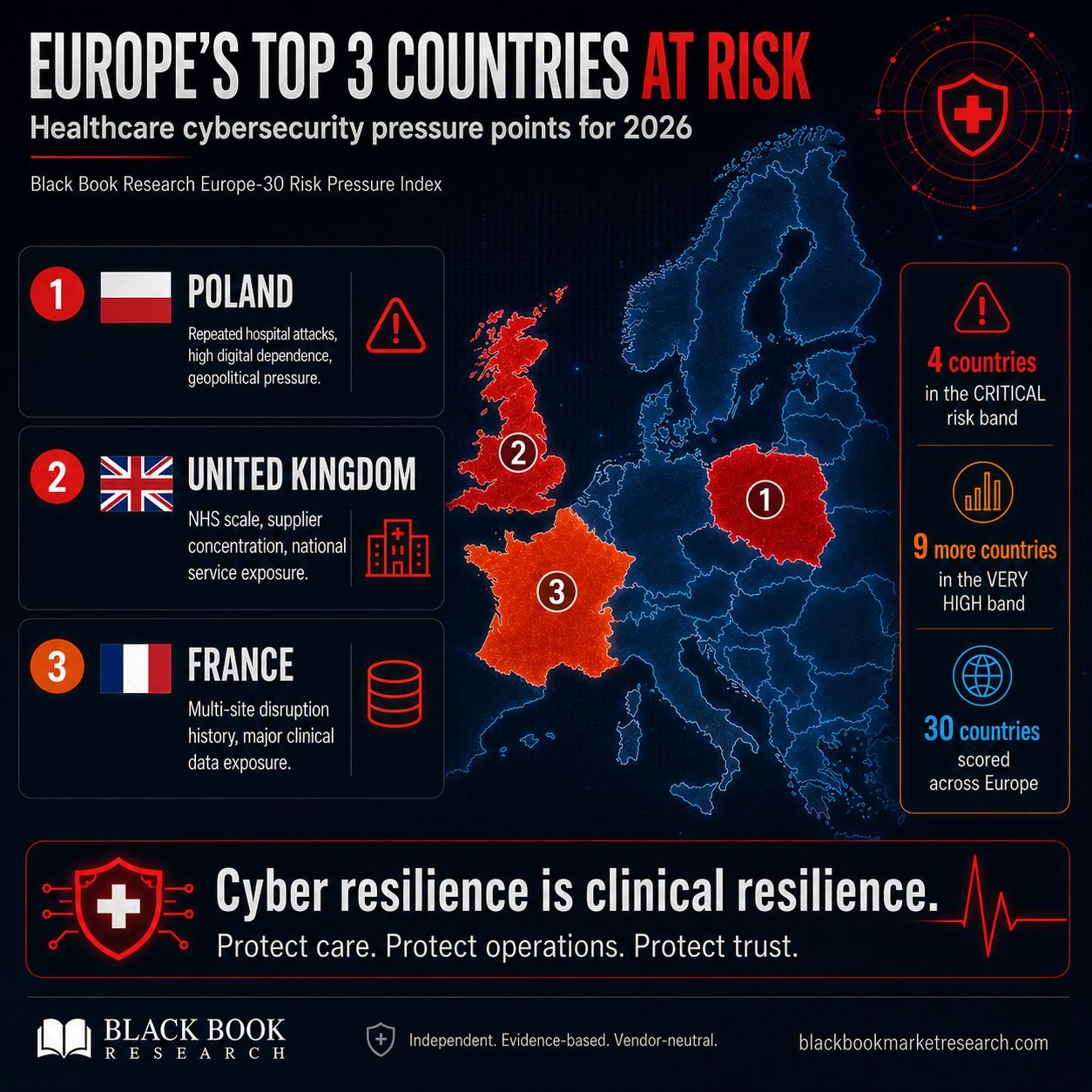
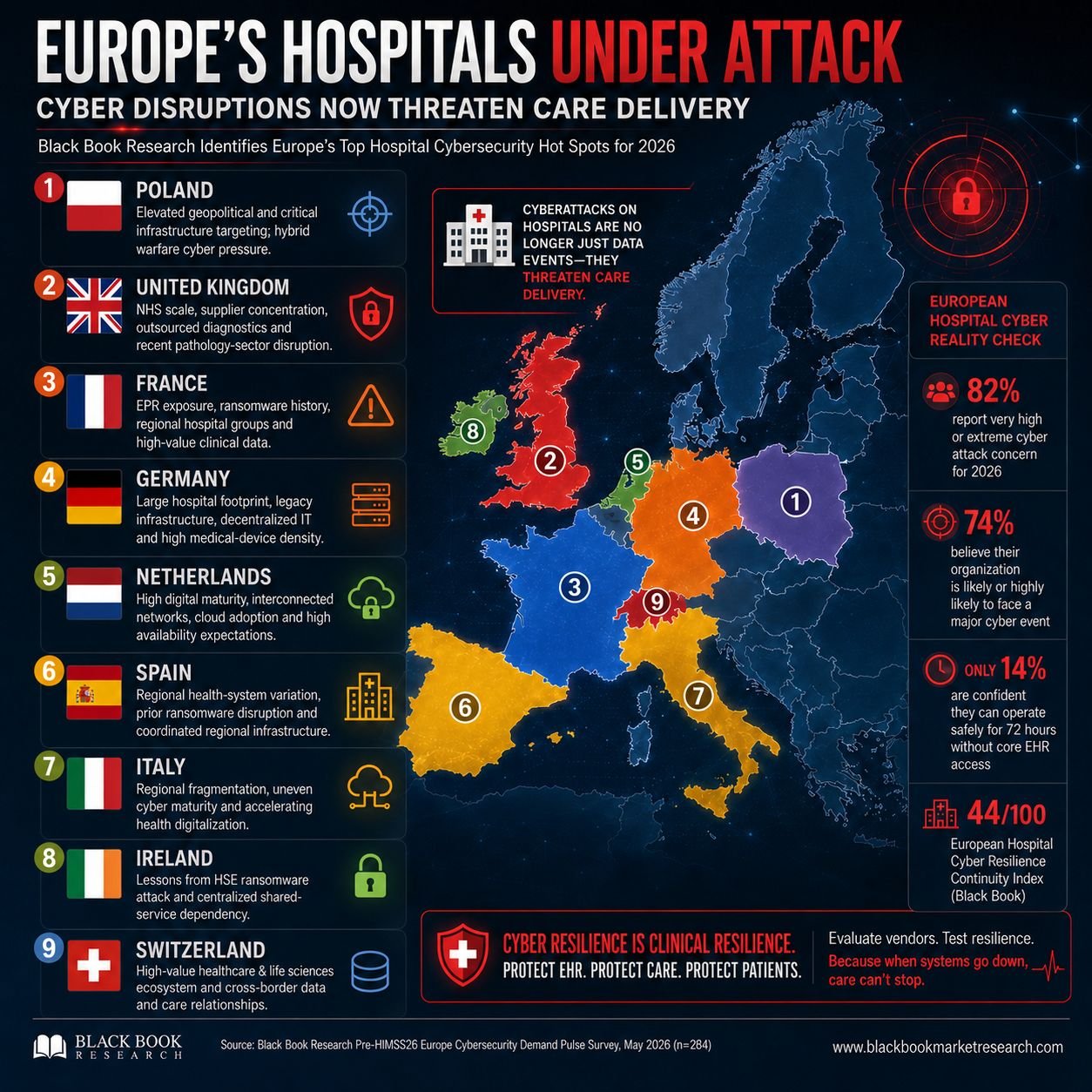
Black Book Research’s 2026 Europe-30 Healthcare Cyber Risk Pressure Index placed 13 of 30 European healthcare markets in its two highest pressure categories. Poland, the United Kingdom, France and Germany were classified as “Critical”, while Belgium, the Netherlands, Romania, Spain, Italy, Ireland, Switzerland, Lithuania and Norway were placed in the “Very High” category.
The index is not a direct ranking of national technical competence. It combines factors including ransomware activity, digital dependence, supplier concentration, healthcare-system scale, geopolitical exposure and the difficulty of recovering from disruption. In other words, it attempts to measure the pressure placed on healthcare systems by the interaction of cyber threats and structural dependence on digital infrastructure.
The European policy environment is also becoming more active. The European Commission’s hospital cybersecurity action plan is organised around prevention, detection, response and recovery. Its measures include a European cybersecurity support centre for hospitals, an EU-wide early-warning service and possible cybersecurity vouchers for smaller healthcare providers.
Who is in the market?
Hospital cybersecurity is not a single product category. It is a collection of overlapping markets.
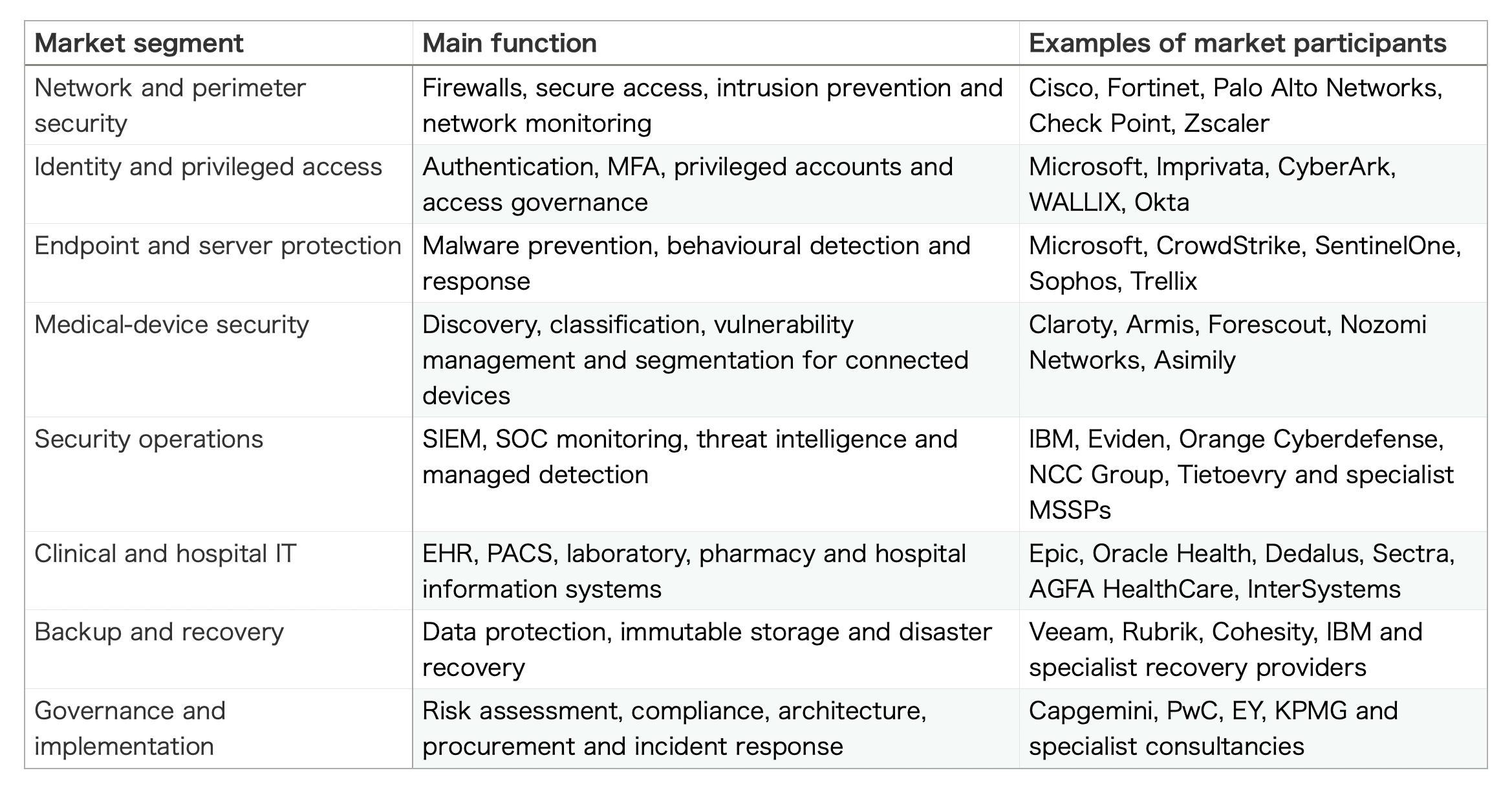
The examples above are illustrative rather than exhaustive. Several companies operate across multiple categories, and the same hospital may purchase products from dozens of vendors while relying on a separate systems integrator or managed-service provider to connect and operate them.
How the stack is assembled
A hospital cybersecurity environment usually develops in layers rather than through a single procurement decision.
The first layer is asset visibility. Security teams need to identify servers, workstations, medical devices, applications, cloud resources and external connections. This is especially difficult in hospitals because equipment may be managed by clinical engineering, biomedical departments, manufacturers or suppliers rather than by central IT.
The second layer is identity control. Users, administrators, service accounts, application interfaces, vendors and medical devices may all require access. Modern security architecture therefore has to manage both human and non-human identities, including API keys, certificates and machine credentials.
The third layer is network enforcement. Segmentation separates clinical systems, administrative networks, medical devices, guest access and building-management systems. Segmentation can limit lateral movement, but it also has to accommodate real clinical workflows and the technical requirements of equipment that may be old or poorly documented.
The fourth layer is detection and response. Endpoint agents, network sensors, cloud logs, identity alerts and application events are collected into monitoring platforms. Security analysts then investigate anomalies, determine their significance and coordinate containment.
The final layer includes data protection and recovery. Hospitals need protected backups, restoration procedures, recovery priorities and trusted administrative access. Those controls have to remain available even when production systems, identity services or vendor connections are compromised.
Where the bottlenecks appear
Fragmented ownership. Responsibility is distributed between the CIO, CISO, infrastructure teams, biomedical engineering, clinical engineering, procurement, legal departments, data protection officers and external suppliers. Each group may understand its own part of the environment without possessing a complete map of the dependencies between them. This creates uncertainty during an incident. A security team may identify a compromised vendor account, while another department controls the contract, a third controls the network connection and a fourth owns the affected clinical application.
Legacy equipment. Many medical devices cannot support conventional security software, frequent patching or modern authentication. Some devices remain in service for many years and may depend on outdated operating systems or proprietary protocols. The available technical response is often compensating control rather than direct remediation. Hospitals may place a device in a restricted network segment, monitor its communications, limit remote access and document its vulnerabilities. This can reduce exposure, but it does not remove the underlying weakness.
Integration complexity. Security tools produce the most value when they exchange reliable information. In practice, hospitals may operate separate consoles for identity, endpoint protection, medical devices, networks, cloud systems and clinical applications. Connecting them can require custom interfaces, specialist knowledge and ongoing maintenance. A tool that detects an incident may not have permission to isolate the affected system, or a platform that disables an account may not revoke an API token or terminate a supplier’s remote session.
Supplier concentration. Hospitals often share suppliers for EHR platforms, cloud hosting, imaging, laboratory systems, managed security, identity services and national health infrastructure. A compromise at one provider can therefore affect multiple institutions simultaneously. Supplier concentration can also limit the practical choice of security controls. A hospital may be able to identify a dependency but lack the contractual or technical authority to alter it quickly.
Vendor access. External support is essential for many hospital systems. Vendors may require remote access for maintenance, troubleshooting and software updates. The resulting accounts, VPN connections, remote-management tools and API integrations expand the hospital’s attack surface. Black Book’s related European research reported that only 13% of organisations had tested a cross-domain kill-switch for their highest-impact vendors and AI platforms. A further 51% had written policies or diagrams without completing an end-to-end test, while 36% had no formal kill-switch. The same research reported a median time of approximately 10 hours to revoke compromised vendor access, with some cases taking more than 30 hours. These figures describe survey responses rather than independently verified incident measurements, but they illustrate the difficulty of coordinating identity, network, application and supplier.
Security operations capacity. Buying a detection platform does not create a security operations capability by itself. Hospitals still need analysts, escalation procedures, threat intelligence, incident-response expertise and appropriate coverage outside normal working hours. This has encouraged growth in managed security services. An external SOC can provide monitoring and specialist expertise, but it introduces another supplier relationship and another dependency to govern. Questions then arise about data location, response authority, access to logs, handover arrangements and the provider’s ability to act during a major incident affecting several customers.
Procurement and regulatory friction. Hospitals procure clinical systems, infrastructure, cybersecurity tools and consulting services through different processes. Contracts may also have different renewal dates, security requirements and incident-notification terms. The European Commission and ENISA are responding to this problem by developing procurement guidance that helps healthcare providers include cybersecurity requirements across the planning, sourcing and management phases of procurement. Procurement guidance can improve consistency, although it cannot by itself resolve technical debt, limited budgets or a shortage of internal specialists.
The integration gap
The healthcare cybersecurity market offers many technically capable products. The more difficult task is assembling them into a system that remains understandable and controllable over time.
A hospital might possess:
a firewall with advanced inspection features;
an endpoint detection platform;
a medical-device inventory;
a privileged-access management system;
a managed SOC;
immutable backups;
a supplier-risk process;
an incident-response plan.
The existence of these components does not prove that they work together. The hospital still needs to know:
Which system has authority to disable a compromised account?
Can a supplier’s access be revoked across VPN, cloud, API and application layers?
Who can isolate a medical-device network?
Which integrations will stop working if a vendor is disconnected?
Where are logs stored if the identity provider is unavailable?
Can backup systems be accessed if the production directory is compromised?
Which external provider can act when several connected organisations are affected?
These are architectural and governance questions as much as product questions.
A crowded market, an unfinished system
The European hospital cybersecurity market is growing in response to ransomware, supply-chain exposure, connected medical devices and expanding regulatory expectations. It includes global technology companies, healthcare-specific vendors, managed-service providers, systems integrators and specialist consultancies.
The market’s main bottleneck is therefore unlikely to be a lack of available products. It is the difficulty of integrating products, suppliers and responsibilities into a system with clear ownership and reliable control points.
Black Book’s findings make this visible. A market can offer sophisticated identity platforms, monitoring services and vendor-management tools while many organisations still lack a tested way to disconnect a compromised supplier quickly. The gap lies between capability and coordination.
The result is a cybersecurity environment that may look comprehensive when viewed through procurement categories, yet remain difficult to operate as a unified system. The next stage of healthcare cybersecurity will depend increasingly on interoperability, dependency mapping, supplier control and tested integration between the many organisations already involved in securing the hospital.